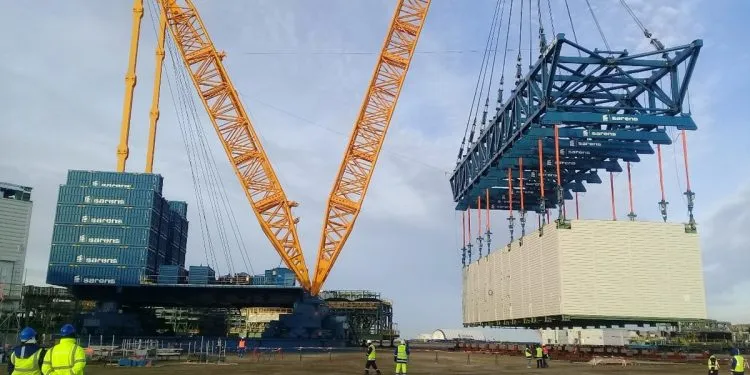
An industry often hidden from view shapes the skeleton of modern economies. It moves machines that do not fit on ordinary trailers. It sets afloat sections of plants that weigh more than most buildings. It clears the path for bridges, power stations, and offshore platforms.
This industry utilizes cranes, barges, self-propelled modular transporters, and teams of engineers to move loads defined by mass, rather than by convention. It operates by the rules of physics and logistics.
It’s called the heavy lifting industry. The industry is global and growing rapidly. Bangladesh sits at a point where demand and constraint meet.
Heavy lifting and heavy transport cover two linked activities. Heavy lifting involves placing loads into their final position. Heavy transport moves those loads from factory gates to work sites. Both demand engineering, planning, and assets built for unusual tasks.

Cranes range from mobile machines on wheels to crawler cranes that walk on tracks. Marine operations use floating cranes, barges, tugs, and semi-submersible carriers. On land, self-propelled modular transporters move structures by inches or kilometers.
Each of these tools has limits in terms of weight, reach, and maneuvering space. Each requires ground that can bear the load or a sea state calm enough for a transfer.
How the industry works
Global forces push demand. The expansion of energy projects, the roll-out of large industrial modules, the construction of transport infrastructure, and the build-out of renewable energy installations need oversized components.
Offshore wind and liquefied natural gas projects, in particular, utilize factory-built modules to minimize on-site work. Modular construction concentrates work in yards that offer deep quays, heavy cranes, and skilled labor. The result is longer but more predictable supply chains. Fabrication concentrates in a few industrial hubs in Asia and Europe. Logistics move the assembled modules across oceans and inland waterways to build sites that often lack the necessary industrial base.
The mechanics of transfer meet simple constraints. Roads and bridges have load limits and width clearances. Quays have load capacities and rail lines for shore cranes. Inland waterways have draft limits and locks. Sea crossings depend on season and ice conditions. Load-out and load-in at a port require precise ballasting, quay reinforcement, and seafastening arrangements.
Route surveys and ground bearing assessments precede any move. Engineers model wheel loads, bending moments, and dynamic effects. They plan for tides, wind windows, and traffic interruptions. When the constraints do not exist, planners build them. Temporary haul roads, jetties, and offloading facilities are common outcomes of one project’s logistics plan.
Technology changes the tools but not the constraints. Cranes now feature sensors that report load, angle, and stress in real-time. GPS and telematics track transporters and vessels. Automation and remote control reduce risk exposure.

These systems provide operators with live data on balance and movement. They do not, however, alter a quay’s structural capacity, a bridge’s load rating, or a narrow channel’s depth. They do help manage those constraints by avoiding sudden, uncontrolled events and by optimizing sequences.
Major projects illustrate the tasks and the trade-offs. Some projects require modules that weigh thousands of tonnes. The modules will not fit under bridges. They will not travel on normal roads. They must be rolled onto heavy-lift vessels, lashed securely, and carried across the oceans.
That process starts in a fabrication yard with deep quays and large gantry cranes. It ends on-site with SPMTs (Self-Propelled Modular Transport), ring cranes, or jacking systems. The middle passage can include ice, shallow waterways, or multiple transshipments. Each transfer adds engineering work. Each delay can push the project schedule.
The Yamal LNG project in Russia demonstrates those logistics. Fabrication for the plant’s modules took place in Asian yards with deep quays and large cranes.
It was built between 2013 and 2019 in Sabetta on the Yamal Peninsula. It is one of the largest modular construction undertakings in history, producing 16.5 million tons of LNG annually.
More than 300 prefabricated modules, some exceeding 10,000 tons, were built in Asia due to its advanced fabrication yards, skilled workforce, and direct marine access.
Transporting them to the Arctic required 30–40-day voyages, icebreaker escorts, and precision load-out using self-propelled modular transporters and heavy-lift vessels. They were loaded onto heavy-lift vessels using SPMTs. Offloading also required a new port, heavy-duty quay works, and SPMT handling to place modules on foundations.
A different constraint appears at landlocked sites such as the Tengiz oilfield in Kazakhstan. This project, valued at around USD 48 billion, aimed at increasing production by 260,000 barrels per day. It relied on massive pre-assembled units and racks weighing up to 1,800 tonnes.
Modules arrived from yards in Korea and Italy. They crossed seas and inland waterways, then moved on to purpose-built haul roads.
The route included a newly built offloading facility and a 71-kilometer cargo corridor, engineered to accommodate axle loads and provide sufficient room for SPMTs to maneuver.
The work involved upgrading bridges, reinforcing roads, and building temporary jetties. Cross-border coordination, inland navigation limits, and seasonal restrictions dictated the plan.
Risks and measures
Failures in this sector carry immediate and visible consequences. A quay collapse or a crane tilt can cause death, injury, equipment loss, and schedule disruptions.
On 22 August 2022, a fatal accident occurred at Keppel Shipyard in Singapore during topside module integration for ExxonMobil’s FPSO Prosperity, part of the Payara project in Guyana.
A section of the quay collapsed beneath a rail-mounted dockside crane, causing it to tilt toward the vessel; its boom deformed over the FPSO, killing one worker and injuring others.
Authorities issued a stop-work order on the affected pier while investigations proceeded. The failure was linked not to the module itself but to the quay structure. Possible contributing factors include structural undercapacity, hidden corrosion damage, foundation weakness, or dynamic overload during crane slewing.
The incident disrupted integration works, destroyed the crane, and damaged part of the pier. Still, the project ultimately stayed on track, with Prosperity achieving first oil on 14 November 2023, ahead of schedule.
Safety practice rests on a sequence of checks. Engineering must certify ground and quay capacity for the specific crane model, wheel loads, and dynamic effects.
Condition surveys should assess corrosion, pile integrity, and settlement. Lift plans must define allowable radii, dynamic limits, and exclusion zones. Monitoring equipment can give early warning of overload or movement. Contingency plans must exist for equipment failure or unexpected weather. Insurers and regulators attach high weight to these steps because a single failure can multiply costs and delay.
Environmental factors shape operations. The weather can stop lifts. High wind prevents crane operation. Rough seas delay offload and voyage. Cold affects hydraulic fluids and the behavior of materials. Natural disasters disrupt transport routes and may damage port structures.
Projects with narrow seasonal windows treat weather as a scheduling constraint rather than a risk to be tolerated. Planners place buffers for delay in timelines and secure contingency vessels and equipment to reduce single points of failure.
Costs in the industry come from equipment, expertise, and time. Heavy-lift cranes, SPMTs, and specialized vessels have high capital costs. Skilled personnel, i.e., engineers, riggers, and marine pilots, carry specialized salaries. Preparatory work, such as route upgrades, temporary jetties, and quay repairs, adds to the budget.
Insurance and contingency allowances form a material part of the risk budget. The concentration of fabrication in a few yards reduces on-site construction time but shifts cost into transport and load-out engineering. Planners choose the least-cost configuration in total, not the cheapest step.
Environmental policy and operational practice intersect in equipment choices. Hybrid power and electric drives for cranes and transporters can reduce fuel use and emissions. The sector has limited low-carbon options for long sea voyages. It can, however, adopt cleaner practices where possible, for example, in port handling and yard operations. The trade-off between emissions and cost enters contracting and procurement decisions for owners and operators.
In Bangladesh
Bangladesh presents a particular mix of demand and constraint. Urbanization, energy projects, ports, and transport infrastructure drive the need for heavy lifting.
Power stations, LNG facilities, and large transport projects require modular components and heavy handling. Local industry includes shipbuilding and heavy fabrication, but the scale of some modules exceeds domestic lifting and load-out capacity.
Constraints include limited heavy-lift cranes, quays with finite load capacity, and roads that require reinforcement for SPMT routes. Skills shortages in specialized rigging and module handling exist alongside opportunities for investment and training.
Foreign yards and foreign equipment currently fill many gaps. Fabrication yards in Asia supply modules that Bangladesh projects may need. Heavy-lift vessels and SPMTs travel from those yards to project ports.
Where ports lack the capacity, project planners build temporary infrastructure. Where roads cannot bear the load, planners upgrade them or create alternate routes. These measures increase project cost but enable larger projects to proceed.
For national planners, the choice narrows to three paths. One path is investment in local yards and quays, to fabricate and load out large modules domestically. That choice requires deep-water quays, large cranes, and a trained labor force.
A second path is strategic procurement: rely on external fabrication while improving port and route capacity to accept and handle incoming modules. The third path is a hybrid of both.
Each path involves public and private decisions on where to place capital, how to train labor, and how to schedule projects that depend on external logistics.
The changing landscape
The industry’s future will depend on three elements. One is technology: sensors, automation, and real-time analytics will reduce some operational risk and optimize the sequence. Two is infrastructure: quays, roads, and yards that match project scale will determine what can be moved and where. There is human capital: trained engineers, riggers, and logisticians will make plans executable.
Countries that align those elements can attract complex projects and reduce the cost of external logistics. Countries that do not will continue to pay for engineered transport paths and temporary works.
Those who follow infrastructure will see an industry that is precise and procedural. It ties port engineering to project schedules. It ties fabrication to transport capability. It ties safety to the capacity of structures that may have once carried only light loads.
The sector shows how a project can build its own access. It shows how a failure in a small part – an old quay, a narrow bridge, a single delayed convoy – can ripple through a program that measures success in years. The facts are as described. The rest is for markets, planners, and engineers to weigh.
Md Farhadul Osmany Riktan is a seasoned engineering and project management professional with over a decade of international experience in heavy lift, transport engineering, and industrial project development. He is the Technical Director at F7 Doors Limited, where he leads strategic projects and oversees technical operations. Having worked with Sarens, Denzai, Fagioli, and Al Jaber Heavy Lift, he has contributed to major LNG, oil and gas, and power projects across Germany, Singapore, Indonesia, Kazakhstan, Saudi Arabia, and Bangladesh. Mr. Riktan holds a B.Sc. in Mechanical Engineering from BUET and an M.Sc. in Bionics/Biomimetics from Germany.
Most Read


Electronic Health Records: Journey towards health 2.0

Making an investment-friendly Bangladesh

Bangladesh facing a strategic test
Understanding the model for success for economic zones

Bangladesh’s case for metallurgical expansion
How a quiet sector moves nations

A raw material heaven missing the export train

Automation can transform Bangladesh’s health sector

A call for a new age of AI and computing
You May Also Like