Bangladesh looks to eco-industrial parks to balance growth and sustainability
BY Insider Desk
February 11, 2026
Economic growth has long relied on large-scale industrialisation. This model has raised output and jobs but has also strained natural resources and social systems. Countries now face pressure to expand industry while protecting the environment, improving working conditions and meeting the Sustainable Development Goals.
Eco-Industrial Parks, known as EIPs, are emerging as one response to this challenge. The idea is not new, but it has gained attention as countries search for ways to align industry with climate and social goals. An EIP promotes cooperation among firms, park authorities, and surrounding communities to improve economic, environmental, and social outcomes.
Bangladesh has begun to explore this approach through the Eco-Industrial Park Light Touch Activities programme under the Global Eco-Industrial Parks Programme. The initiative is led by the United Nations Industrial Development Organization, with financial support from Switzerland’s State Secretariat for Economic Affairs.
Traditional industrial parks often focus on land, utilities and tax incentives. Environmental impacts, worker safety and resource use are addressed later or not at all. This has contributed to pollution, climate risks and uneven development. Workers and nearby communities have often borne the cost.
Some countries responded by clustering industries to share infrastructure and reduce logistics costs. EIPs build on this model. They add planned systems for resource efficiency, environmental protection and social standards.
UNIDO, the World Bank Group and the German development agency GIZ jointly developed an international framework for EIPs. Under this framework, an EIP is an industrial area that promotes collaboration across firms and with communities to improve economic performance, social outcomes and environmental management.
The framework defines four performance areas. Environmental performance covers energy, water, waste and pollution control. Economic performance includes job creation, support for small firms and local value chains. Social performance focuses on decent work, safety and community engagement. Park management covers governance, planning and monitoring.
A World Bank survey in 2021 identified at least 438 EIPs worldwide, with numbers rising. This growth reflects a shift in thinking. Environmental and social risks are now seen as economic risks as well.
Industrial symbiosis sits at the centre of the EIP approach. Firms share energy, water, materials and by-products so that waste from one process becomes input for another. This cuts costs and reduces resource use. In Denmark’s Kalundborg industrial area, surplus heat from power plants is used for homes and fish farms, while industrial by-products are reused by other firms. Similar models are now being tested in Asia and Africa.
Countries such as Vietnam and Indonesia have adopted EIP approaches to improve competitiveness, increase renewable energy use and cut emissions. UNIDO launched the Global Eco-Industrial Parks Programme in seven countries in its first phase, including Vietnam, Indonesia and South Africa. The second phase extends support to more countries, including Bangladesh, through lighter policy and capacity support.
The Bangladeshi government has partnered with UNIDO to explore EIP adoption as a way to respond to these pressures. The Light Touch Activities programme focuses on awareness, policy analysis, benchmarking, training and dialogue. It does not fund new infrastructure.
Several national consultations were held to move ideas into practice. A policy roundtable in September 2025 reviewed existing laws and strategies, including the Industrial Policy 2022 and climate commitments. Participants agreed that these policies support sustainability in principle but lack clear implementation tools. They also noted overlapping mandates among industrial authorities.
Experts called for a national EIP policy aligned with global standards, incentives for resource-efficient technologies, stronger monitoring systems and training for park authorities and small firms.
A second consultation in December 2025 focused on a just transition. Participants stressed the need to link EIP ideas with education and training systems, strengthen ties between industry and universities, and design social facilities, such as childcare, housing, and healthcare, within parks.
Later that month, another roundtable examined how EIPs could support national goals. Participants called for shared data systems to track resource use, support for energy efficiency and renewable power, and tailored strategies for older industrial areas. They warned that small firms and informal businesses must be included if benefits are to be shared. Many agreed that early action should focus on water and wastewater management.
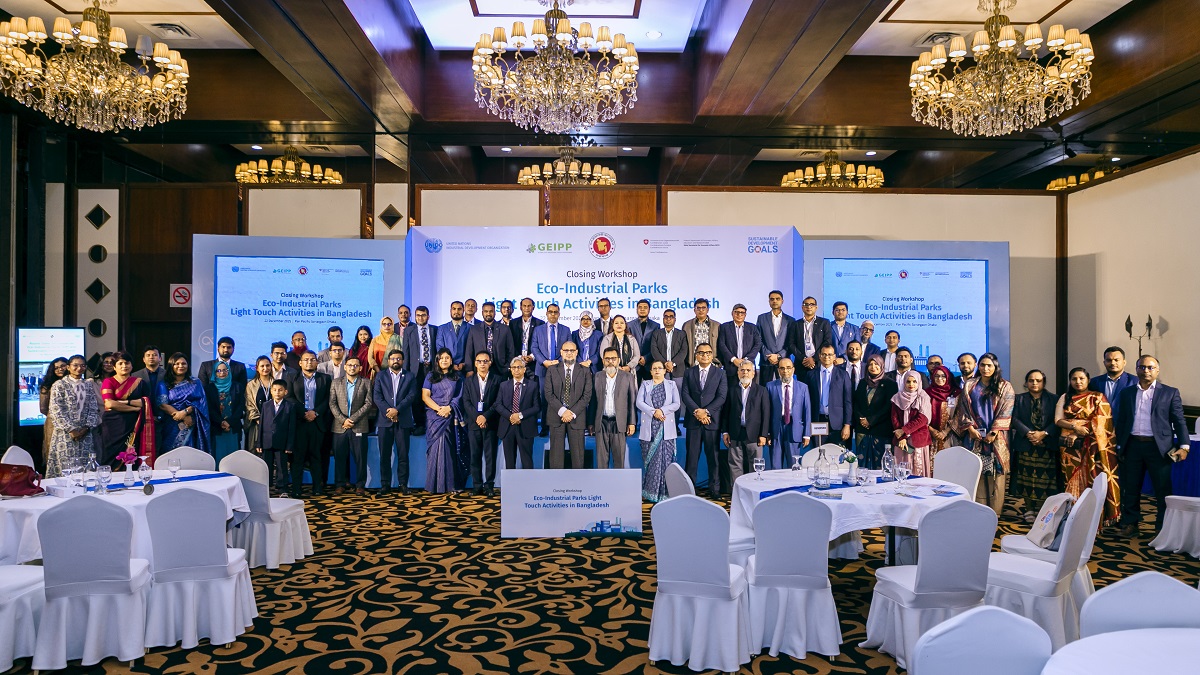
The programme concluded with a closing workshop in December 2025. Participants agreed that EIPs should be seen as governance frameworks rather than construction projects. Strong policy coordination, data systems and clear benchmarks were seen as essential. Government officials said national policies would be updated to reflect EIP principles. Private sector representatives expressed interest in shared infrastructure and circular economy practices.
Bangladesh’s next challenge is to move from dialogue to action. This will require embedding EIP principles in national policies, training officials and park managers, building data platforms, and creating finance tools to support change. Pilot projects in selected parks are expected to help build confidence and evidence.
Eco-Industrial Parks are not a quick fix. Progress is likely to be gradual and uneven. Yet global examples show that the approach can reduce costs, improve resilience and support jobs when supported by clear rules and cooperation.
Most Read

Starlink, satellites, and the internet
BY Sudipto Roy
August 08, 2025
What lack of vision and sustainable planning can do to a city

A nation in decline
From deadly black smog to clear blue sky
Understanding the model for success for economic zones

How AI is fast-tracking biotech breakthroughs

Environmental disclosure reshaping business norms

Case study: The Canadian model of government-funded healthcare
A city of concrete, asphalt and glass

Does a tourism ban work?
You May Also Like